
Safe Streets Program
CKL Safe Streets Program is a community initiative aimed at reducing speeding and promoting safe driving. The foundation of this program is an interactive online dashboard.
From the Dashboard you can:
- Submit a traffic management request by clicking on the “Open New Safe Streets Form” button.
- Review the status and results of previously submitted Safe Streets requests.
Submit a Safe Streets Form
For a specific road concern, residents can complete the CKL Safe Streets Form from the Dashboard or by navigating directly to the form.
- Please review the process outline below to learn about the next steps for each type of request.
- The CKL Traffic Management Team will investigate recent studies to determine if updated data is required. If needed, the necessary traffic studies will be scheduled.
- Staff will analyse the data and perform any necessary warrants.
- You will be contacted to discuss the findings once the data has been reviewed and a determination has been made.
Process Outline
Based on regulations, policies, and best practices, the process for each type of traffic request may be a little different. You can learn about the processes below:
Heavy Truck Restrictions
In general, heavy trucks should be using the arterial and collector road system. Local roads accommodate primarily passenger vehicles, light to medium sized trucks and the occasional heavy truck.
When you submit a heavy truck restriction request, staff will collect the necessary vehicle class data and compare with similar roads with similar roadside environments. Heavy truck restrictions may be warranted on local roads showing an elevated heavy truck use, in the total amount or the percentage of overall traffic.
It is important to ensure that the traffic will not be diverted to other local roads that may be less suitable to handle it.
When staff have made a determination, you will be contacted with the results. It heavy truck restrictions are recommended, staff will report to Council for the passing of the necessary By-laws.
Parking Restrictions
Parking often reflects competing local interests. Therefore, if no immediate safety issue is identified, community support should be demonstrated. To do this, you can submit a petition to Council.
When you submit a parking restriction request, staff will investigate if there is an immediate safety issue that can be mitigated by the restriction of parking.
When a determination has been made, you will be contacted with the results. If Engineering staff did not deem it a safety issue, the request will require a petition to Council to demonstrate community support. If parking restrictions are recommended, staff will report to Council for the passing of the necessary By-laws.
Pedestrian or School Crossing
Pedestrian crossings and supervised school crossings are related but have different standards and warrant procedures. When you submit a request for a crossing, staff will collect the necessary traffic and pedestrian data and apply the warrant as prescribed by the Ontario Traffic Manual, or the Ontario Traffic Council.
When completed you will be contacted with the results. If a crossing is warranted, staff will begin the budgeting and design process.
Report Speeding
Part of the Safe Streets Program will be regular meetings between City staff and enforcement agencies (OPP and KLPS).
When you report a concern for speeding, staff will collect the speed data. A summary report of the speed data will be provided to the appropriate enforcement agency who can use the data to determine enforcement priorities.
Since the decision for enforcement initiatives lay outside of City staff, we are unable to provide follow up contact.
Speed Limit Reduction
When you submit a speed limit reduction request, staff will perform the warrants as set out by the Transportation Association of Canada’s (TAC) “Guidelines for Establishing Posted Speed Limits”. The warrant consists of performing speed analysis studies and investigating the road risks to determine appropriate speed limits according to road engineering characteristics, geometry, roadside environment, road classification, land use, access/intersection density, and vulnerable road users.
When complete, you will be contacted with the results. If a lowered speed limit is recommended, staff will report to Council for the passing of the necessary By-laws.
The typical timeline for a warranted speed limit reduction from the time of request to the installations of the road signs is up to a year.
Stop Signs or All-Way Stops
All-way stops are not to be used for speed control or traffic calming. Traffic calming has its own process. However, as traffic patterns change and grow, a new all-way stop may be an appropriate right-of-way control for an intersection.
When you submit an all-way stop request, staff will collect the necessary turning movement data and apply the warrant as prescribed by the Ontario Traffic Manual. The warrant accounts for total traffic volume, the volume split between approaches, and delay to traffic entering the intersection. Collision history is also analysed.
When completed you will be contacted with the results. If an all-way stop controls is recommended, staff will report to Council for the passing of the necessary By-laws.
The typical timeline for a warranted all-way stop from the time of request to the installations of the road signs is up to a year.
Streetlight (Illumination)
For urban development, and rural built-up area development, it is assumed that the current lighting (or lack thereof) was approved according to the standards at the time of site plan development. CKL does not consider new streetlights on existing developments using current standards.
When you submit a request for streetlights, staff will collect the necessary traffic data and apply the warrant as prescribed by the Transportation Association of Canada. The warrant accounts for geometric factor such as channelization, sight distances, curvature, and angle of intersection. Operational factors are analysed including traffic volumes, nighttime pedestrian volumes, classification and speeds. Collision history is also analysed.
If warranted, staff will budget for the design and installation of the new streetlight. Timing of which is dependant on the complexity of the installation, and the presence of existing infrastructure.
Traffic Calming Review
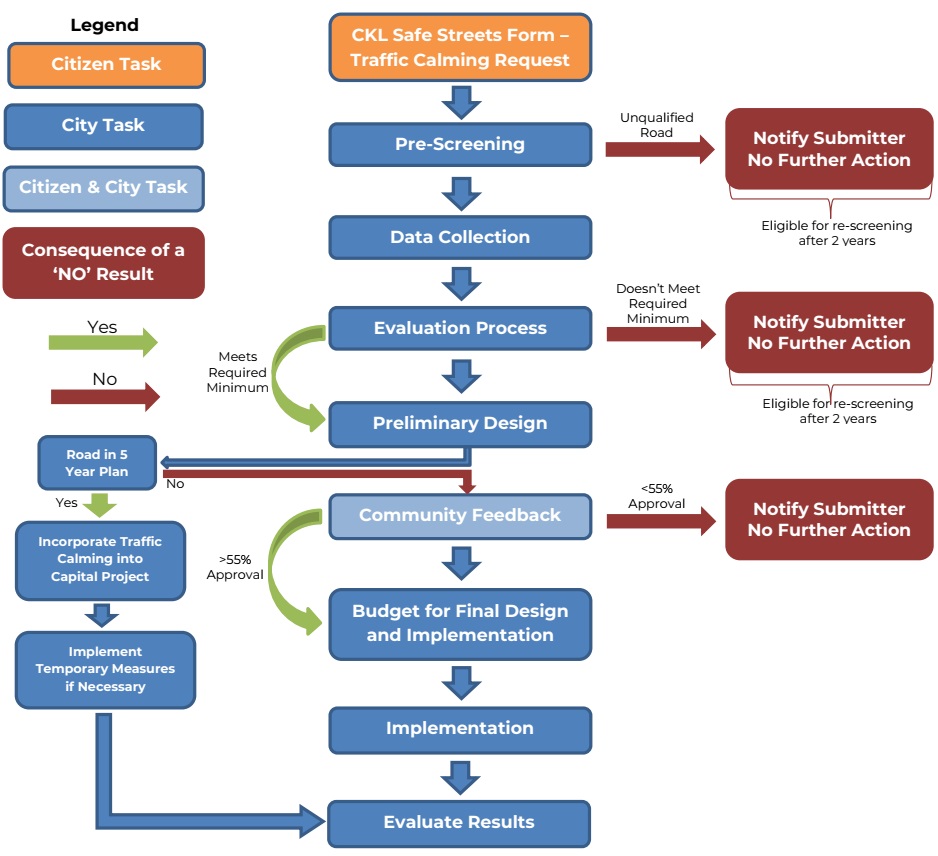
When you submit a traffic calming review request, staff will move through the process as per the draft Traffic Calming Policy.
1. Request from residents through the Safe Streets Online Form
2. Pre-screen evaluation
3. Data collection
4. Final evaluation
5. Resurfacing schedule review
6. Preliminary design
7. Community feedback
8. Budget for final design and implementation
9. Implementation
10. Evaluate Results
After a submission is received, staff proceeds with a warrant to determine if the road is a suitable candidate for an engineered form of traffic calming. Screening criteria include the analysis of volumes, speeds, road classification, and the use of the roadside land. If the road does not meet the screening criteria, alternative measures can be considered such as temporary electronic speed signs, education campaigns, additional warning signage, and enforcement initiatives.
You will be contacted with the results of the warrant. If traffic calming is warranted, staff will review the opportunity to incorporate traffic calming features into upcoming resurfacing projects. If the road is not scheduled for resurfacing in the next five years, a stand-alone project is considered.
For stand-alone traffic calming projects, a capital project budget item will be requests for the year following the warrant.
Traffic Signal
This category covers phase timing at existing traffic signals as well as the need for new signals at currently unsignalized intersections. To report a malfunctioning traffic signal component, please contact Customer Service.
The future need for traffic signals is usually identified through Corridor Studies and our Transportation Master Plan. That way resources can be responsibly allocated in the long-term financial plan. These studies predict growth and development, however as traffic patterns change or unpredicted development occurs the immediate need for traffic signals can be addressed.
When you submit a request for a new traffic signal, staff will collect the necessary turning movement data and apply the warrants as prescribed by the Ontario Traffic Manual. The warrants account for total volumes, delay to cross traffic, collision experience, and pedestrian volumes.
When completed you will be contacted with the results. Intersections which meet the warrants for traffic signals will be eligible for the installation of an interim all-way stop to allow for the design and construction of the signals to be budgeted into the long-term financial plan.
As traffic patterns change, it is appropriate to ensure the phase timing at existing intersections are optimized for efficiency. A city-wide phase timing optimization review project is scheduled for 2028. In the meantime, when you submit a request to review the phase timing of a traffic signal, staff will determine if there is an immediate need to adjust the timing. You will be contacted with the results.


